
In 2026, the strategy for business energy independence in Pakistan has shifted significantly due to soaring electricity tariffs and the transition to a Net Billing model. To achieve true self-sufficiency, savvy businesses are moving beyond simple installations to sophisticated “oversized” solar designs.
1. The 2026 Strategy: From Exporting to Self-Consumption
The financial value of solar no longer lies in selling power back to the grid at low rates (approx. Rs. 8–11 per unit) under the new Prosumer Regulations. Instead, the goal is to avoid buying grid power at retail rates (Rs. 50–65 per unit).
- Self-Consumption focus: Aligning production with business hours ensures you use every unit generated internally.
- Load Shifting: Scheduling heavy machinery or cooling cycles during peak sunlight (11 AM – 3 PM) maximizes free solar energy.
2. Why “Oversizing” is the New Standard
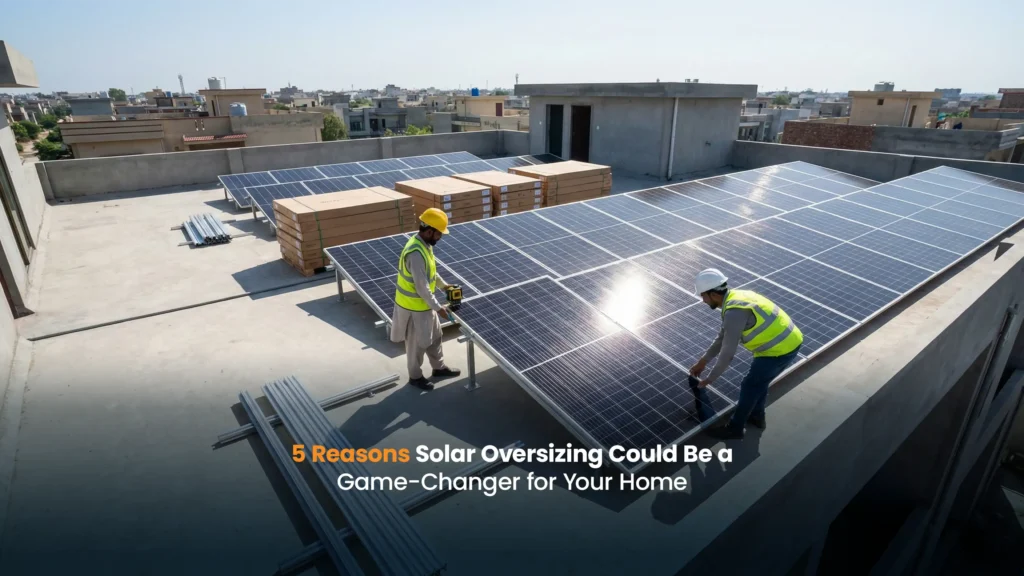
“Oversizing” (or overpaneling) involves installing more solar panel capacity (DC) than your inverter’s rated output (AC). For example, a 100kW inverter might be paired with 130kW of panels.
- Maximum Daytime Harvest: An oversized system reaches the inverter’s full capacity earlier in the morning and maintains it until late afternoon, providing a “wider” window of peak power.
- Mitigating Real-World Losses: Factors like dust, high Pakistani temperatures, and shading mean panels rarely hit 100% output. Extra panels ensure the inverter stays at peak performance despite these factors.
- Cost-Effectiveness: Adding extra panels is far cheaper than upgrading an inverter or electrical infrastructure.
3. Integrating Battery Energy Storage (BESS)
Self-sufficiency is incomplete without a way to store excess energy.
- Peak Shaving: Store energy during the day to power operations during the expensive peak hours (typically 6 PM – 10 PM).
- Uninterrupted Business: BESS replaces noisy, high-cost diesel generators during load shedding, ensuring seamless operation.
- Charging during “Clipping”: When panels produce more than the inverter can process (clipping), DC-coupled batteries can often capture that “wasted” energy directly.
4. Financial & Operational Benefits
| Benefit | Impact for Pakistani Businesses |
| Rapid ROI | Payback periods have dropped to 3.5–5 years as grid costs rise. |
| Inverter Efficiency | Inverters operate most efficiently when running at 50%–80% load; oversizing keeps them in this “sweet spot” longer. |
| Future-Proofing | Extra panel capacity accounts for future energy growth, such as adding electric vehicles (EVs) or new production lines. |
| System Stability | Larger arrays handle fluctuations from cloud cover or sudden weather changes more effectively. |
5. Implementation Roadmap
- Right-Sizing: Target a DC-to-AC ratio of 1.2 to 1.5, depending on your load profile.
- Tier-1 Components: Use only high-efficiency panels and inverters that support smart monitoring and BESS integration.
- Active Maintenance: Implement automated cleaning to fight the performance drops caused by local dust and pollution.