

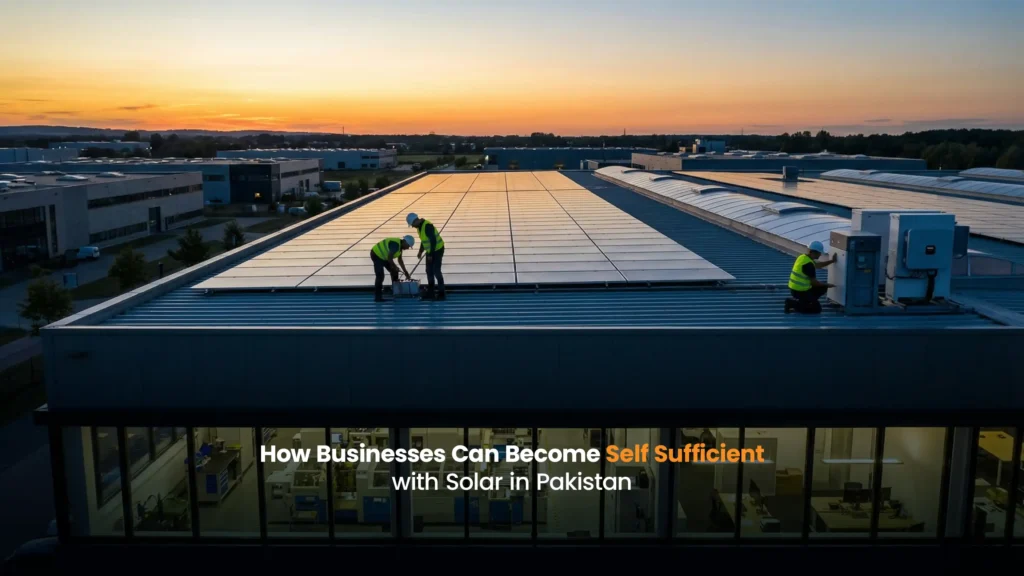
In 2026, the energy landscape for businesses in Pakistan has reached a critical turning point. With electricity tariffs for commercial and industrial (C&I) sectors soaring to Rs. 50–65 per unit and the recent introduction of the NEPRA Prosumer Regulations 2026, “business as usual” is no longer an option.
The goal has shifted from simply lowering a bill to achieving energy self-sufficiency. Here is a detailed guide on how Pakistani businesses can navigate this new reality.
1. The Strategic Shift: From Net Metering to Net Billing
As of February 2026, Pakistan has officially transitioned from the “one-for-one” unit exchange of Net Metering to a Net Billing model.
- The Old Way: 1 unit exported = 1 unit offset (worth ~Rs. 40+).
- The New Way (2026): Exported units are now bought by the grid at the “National Average Energy Price” (approx. Rs. 8–11 per unit), while imported units are billed at full retail rates.
- The Strategy: To become self-sufficient, businesses must focus on Self-Consumption. The financial value is no longer in “selling” power to the grid, but in avoiding the purchase of expensive grid power.
2. The Blueprint for Self-Sufficiency
To achieve true independence, a business must move beyond just “slapping panels on a roof.”
A. Right-Sizing and Load Profiling
Previously, businesses oversized systems to earn credits. Now, the goal is to match your solar generation curve with your operational hours.
- Daytime Operations: If your factory or office runs 9 AM to 5 PM, aim for a system that covers 90% of your peak daytime load.
- Load Shifting: Move energy-intensive processes (like water pumping, heavy machinery startups, or cooling cycles) to peak sunlight hours (11 AM – 3 PM).
B. Integrating BESS (Battery Energy Storage Systems)
In 2026, batteries are no longer a luxury; they are the heart of self-sufficiency.
- Peak Shaving: Use batteries to power the business during “Peak Hours” (usually 6 PM – 10 PM) when grid rates are highest.
- Uninterrupted Operations: BESS eliminates the need for expensive diesel generators during load shedding, which can cost 3–4x more than solar-plus-storage.
C. The Hybrid Advantage
While “Off-Grid” is the ultimate dream, a Hybrid System is the most practical for 2026. It allows you to:
- Prioritize Solar for immediate use.
- Store excess in batteries.
- Use the grid only as a last resort or for “Net Billing” small surpluses.
3. Financial Incentives & ROI in 2026
Despite policy changes, the ROI for commercial solar remains strong due to the sheer cost of grid electricity.
| Feature | Impact for Businesses |
| Payback Period | Typically 3.5 to 5 years (down from 7 years in 2020). |
| Asset Lifespan | Tier-1 panels now offer 25–30 year performance warranties. |
| Green Financing | Many local banks offer SBP-backed or private renewable energy loans at competitive rates. |
| Tax Benefits | Accelerated depreciation allows businesses to write off a large portion of the solar investment against taxable income in the first year. |
4. Operational Maintenance: Protecting Your Investment
Pakistan’s environment (dust and heat) can reduce efficiency by 20–30% if ignored.
- Automated Cleaning: For large-scale industrial rooftops, consider robotic cleaning systems to maintain maximum yield.
- AI Monitoring: Use smart inverters with AI-based analytics to identify underperforming strings or maintenance needs in real-time.
5. Steps to Start Today
- Energy Audit: Analyze your last 12 months of bills and your hourly load profile.
- Structural Assessment: Ensure your rooftop or land can support the weight and wind-load of modern high-wattage panels (550W+).
- Choose Tier-1: Only use “Tier-1” Bloomberg-rated panels (like LONGi, Jinko, or JA Solar) and reputable inverters (Solis, Huawei, Sungrow) to ensure the system lasts 25 years.
- Legal Compliance: Ensure your installer is PEC (Pakistan Engineering Council) and AEDB certified to handle the new 2026 Net Billing licensing.
The Bottom Line
In 2026, energy is a top-three expense for most Pakistani businesses. By pivoting to a self-sufficiency model prioritizing direct consumption and battery storage you don’t just “save money”; you insulate your business from the volatility of the national grid and gain a massive competitive advantage.